C-Store Valuations
|
 |
C-Store Appraisals
|


|
Appraisal Book
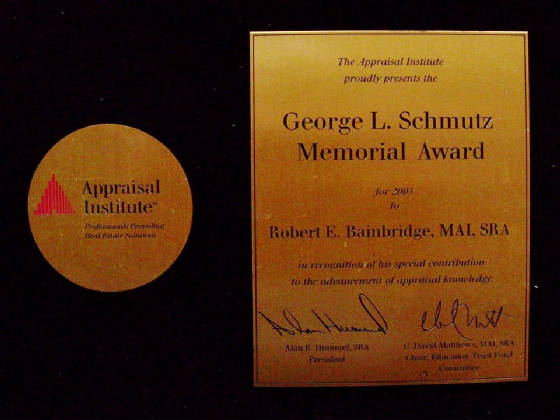
AWARD WINNER Winner of the 2003 George M. Schmutz Award for outstanding technical manuscript or publication.
“I'd recommend this comprehensive book to anyone who wants to gain a better understanding of a convenience store/retail fuel property from site planning to store operations." L- John A. Schwartz, MAI
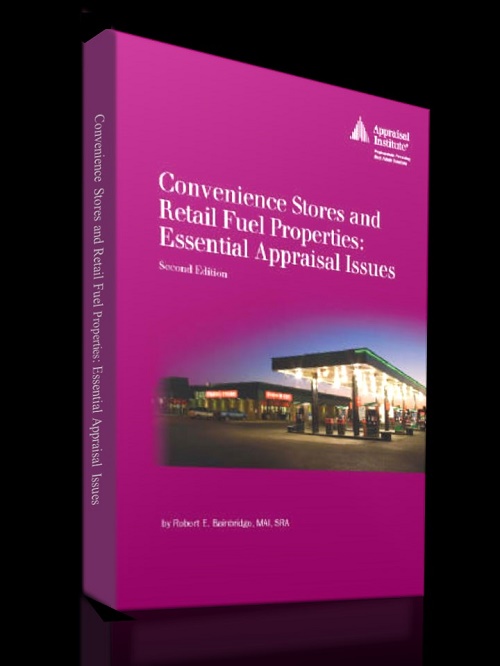
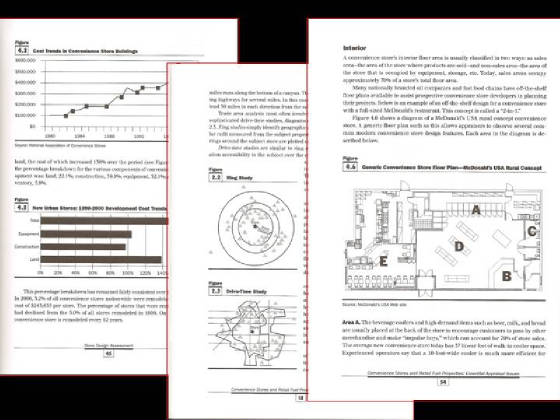
APPRAISAL You may order this book from the Appraisal Institute's website by clicking the link below. APPRAISAL Please Click Here to Purchase Our Book from the Appraisal Institute. APPRAISAL APPRAISAL From the Introduction to Convenience Stores and Retail Fuel Properties: Essential Appraisal Issues SECOND EDITION Today’s convenience store occupies a unique place in the retail landscape. With over 146,000 convenience stores across the USA, more than 117,000 sell motor fuel. Eighty percent of all motor fuel sold in the United States is sold through the convenience retail channel. This business model of motor fuel sales combined with a limited selection of high-turnover merchandise is the subject of this book. Convenience stores are special-built properties that are designed to make money in only one way. They are not easily adapted to other uses. The fundamental determinant of value for a convenience store property is its ability to generate earnings. This book is written to help the reader understand the market forces and design features that create and influence the property value of convenience stores. Chapters 1 through 9 are essential preliminary background to understanding the factors that create value. Chapter 10 applies this knowledge through the three approaches to valuation. Simply stated, the value of a convenience store is a product of the characteristics of the trade area within which the store operates in addition to the physical features of the site and improvements. Chapter 1 discusses the convenience industry. Current trends in motor fuel retailing and in-store sales are presented along with sources of data that the appraiser should be familiar. The long-term trends in the industry establish the 5 to 10-year price-movement for the real estate. So, it is important for the appraiser to know where the convenience industry is today and where it is going. Fundamentals of economic theory applied to retail real estate are presented in Chapter 2. Understanding the interaction of supply and demand in perfectly competitive markets is presented for a basis of discussion on how economic profit is created for the business enterprise. All convenience stores operate within a specific trade area. Whether that trade area is over-supplied or under-supplied has a profound influence on value. The supply and demand characteristics of the trade area determine the short-term movement of property value over the next two to five years. A trade area analysis is one of the weakest area in most appraisal reports. Chapter 3 shows the appraiser how to delineate the trade area, measure supply and demand, and discusses important sources of data and analytical tools. Chapter 4 helps the appraiser to analyze the site. Today’s standards for convenience store sites are discussed, including examples of site development criteria from major retailers and oil companies. Related to site access and visibility, the specialized topic of eminent domain issues as they relate to convenience retail properties are explored in Chapter 5. Examples of the economic impact of access degradation for convenience retail real estate are included in Chapter 5. Store building assessment is addressed in Chapter 6, and the Fuel Service and Equipment are treated as separate topics in Chapter 7 and Chapter 8. Industry average cost trends over the last ten years are provided in each of these chapters. Highest and Best Use considerations for convenience stores are covered in Chapter 9. Acquisition and redevelopment decisions are presented as well as the effects of increasing land values on the highest and best use of a convenience store are presented. Chapter 10 addresses the valuation of convenience stores. All three approaches are discussed. However, in accordance with Guidance Note 12 of the International Valuation Standards the most emphasis is placed on the capitalized earnings approach as it applies to the total assets of the business. Because it is a component part of these assets, the value of the real estate dependent on earnings capacity. This is the fundamental premise of the value of a convenience store. Looking ahead, Automated Valuation Models (AVMs) for commercial property are one of the most promising developments in the appraisal profession today. AVMs will play an increasingly important role in the future of commercial property valuation as more abundant and better quality market data becomes widely available. Chapter 11 presents a prototype AVM for convenience stores based on the valuaion premises discussed in this book. Comments on model design and measures of explanatory and predictive capability are included in Chapter 11, along with a discussion of some of problems commonly encountered and suggestions for further research. XXX In Appendix A, the reader will find releveant material on the North American Industry Classification System (NAICS) codes for retail real estate, which are useful for accessing demographic data sources such as Site To Do Business. Other appendices cover the International Valuation Standards, the International Financial Reporting Standards, FIRREA, and USPAP. XXX For a practical application of the valuation principles discussed in Chapters 1 through 10, the Appraisal Institute offers an online seminar, "Appraising Convenience Stores", which includes a case study covering the topics presented in this book. The seven-hour seminar is available through the Appraisal Institute at http://www.appraisalinstitute.org/. |
|||||||||||||||||||||||||||