C-Store Valuations
|
 |
Litigation Issues
|


|
On This Page (Scoll Down)
Valuation
ATTORNEYS 1. Solving Recent Litigation Valuation Problems
ATTORNEYS
APPRAISAL
VIRGINIA – We were asked to estimate the impact on the fair market value of the real estate caused by temporary access degradation where the entry and exit points to the convenience store would be substantially impaired during road construction over a period of several months. APPRAISAL APPRAISAL
MINNESOTA – A regionally-branded convenience store in the Minneapolis Metro Area had right-in, right-out access in the before condition. After the take, access was reduced to right-in only from the arterial roadway. In the after-condition, customers must exit the property by a series of collector streets with several additional turning movements. We were asked by the condemning agency to estimate the impact on market value of this access degradation.
APPRAISAL
ARIZONA – We were asked to review the methodology of the appraisal reports prepared by the property owner’s appraiser and condemning agency on a large travel center/truck stop in Phoenix.
APPRAISAL APPRAISAL attorney Litigation VALUATION
NORTH CAROLINA – In this case, the property owner’s attorneys desired to take the case to the North Carolina Supreme Court and overturn a previous ruling on the compensability of business, or intangible asset, value. We were asked to estimate the fair market value of the real estate and intangible asset value.
APPRAISAL
MINNESOTA – The State of Minnesota allows compensation to intangible assets, or “going concern value” as it’s called in Minnesota, during a whole take in condemnation. We were asked by the condemning agency to estimate the fair market value of the intangible assets of a convenience store in condemnation even though the property owner did not provide profit and loss statements.
ATTORNEYS
VALUATION
TEXAS – High-performance convenience stores pose a significant appraisal problem because of the lack of comparable sales. These stores often have location advantages that cause them to operate at much higher sales and margins than industry norms. We were asked to estimate the fair market value of the real estate. The key to an accurate estimate of market value is the trade area analysis measuring supply and demand, customer demographics and hypermarket competition. attorney
VALUATION
FLORIDA – In this civil litigation case, a deed restriction was violated when a new convenience store was constructed adjacent to the client’s existing store. We were asked to estimate the economic damages to the client’s store and found a that the existing store will incur substantial economic harm and loss of value.
ATTORNEYS
RHODE ISLAND – A dispute arose in this civil litigation case where the seller of seven convenience stores took issue with how the buyer allocated real estate and intangible assets. The buyer employed an accountant to make the segregation resulting in increased income tax liability for the seller. We were asked to act as a subject matter expert in explaining the economic allocation to the assets involved in the sale.
ATTORNEYS
TEXAS – We were asked by the condemning agency to act as a subject matter expert in countering the property owner’s claim that the store enjoyed a monopolistic location because of a building moratorium on new retail fuel properties over the Edward’s Aquifer in San Antonio. We also assisted the condemning agency’s attorney in preparing the deposition questions of the property owner. VALUATION
attorneys
NORTH CAROLINA – In this civil litigation case of a divorce settlement involving over 150 convenience stores in North Carolina and Virginia, we were hired as a subject matter expert to guide and assist the local appraiser who was not an expert in convenience store appraisals. Our work included reviewing the deposition transcripts of the client to ensure no previous testimony conflicted with the facts and assumptions in the appraisal reports.
MISSOURI – In this civil litigation case involving a divorce settlement, we were asked to appraise the fair market value of a convenience store in the southwest corner of Missouri. Although located in a rural area, this was a high-earnings store because of a near-monopolistic location. The key to a credible appraisal was an accurate trade area analysis measuring supply and demand.
APPRAISAL LAWYERS VALUES
NORTH CAROLINA – We were engaged to complete before and after appraisals on a convenience store in Charlotte. In the after condition, the arterial roadway was elevated creating a driveway slope greater than 5 percent. This slope in the after condition precluded fuel delivery tank wagons from accessing the property which changed the highest and best use.
LAWYER VALUE
TEXAS – In this civil litigation case, the attorney believed the client's landlord engaged in predatory business practice in establishing the lease terms for three stores in the Dallas Metro Area. We were asked to perform detailed financial analyses showing the lessee could not pay the contracted rental amounts from store earnings.
CONDEMNATION APPRAISALS 2. TRPs: Intangible Assets as a Compensable Damage
Trade-Related Property is a classification of commercial, income-producing real estate that is different from other types of income property. The real estate of Trade-Related Property (TRP) is designed to generate income and profit from a single, business-related use. We have all seen examples, such as convenience stores, gas stations, car washes, movie theaters, and bowling alleys. TRPs are distinct from other income-producing property where their profit is part of the rental income from the real estate. Non-TRPs include apartments, shopping centers and office buildings. With these, no business-related profit is generated for the property owner.  AAA
Nichols summarizes that the spirit of condemnation law is to “make the property owner whole”. After all, the property owner is being obliged to sell, often against his desire. Our condemnation laws do not distinguish between TRPs and non-TRPs. Yet, they should. The fairness of the compensation to the TRP property owner is significantly different.
For all TRPs, the motivation and reason for owning the real estate is the profit, or business income that is earned over and above the economic requirements of the real estate. In other words, all operating TRPs earn more than the real estate is worth. If they didn’t, no one would own them. Using a convenience store as an illustration, the average pre-tax profit today is about $47,000 per year. This is the reason the convenience store operator purchases or builds the real estate: to earn this $47,000 per year of business profit that is over and above the investment requirement in the real estate. The real estate is simply a means to this end. A trained workforce, negotiated supplier contracts, in-place management, and assumption of risk are some of the elements that produce this profit.
Courts across the nation have ruled that business profit is not compensable, reasoning that the property owner has the ability to transfer the business to another location and continue to receive profits. So, the courts limit damages exclusively to the real estate. For TRPs, important elements are missing from this line of reasoning.
In a condemnation taking, the TRP owner has one of two relocation alternatives. He can purchase an existing property or build. Continuing with a convenience store as an example, in the first instance all sellers of operating stores demand something for their on-going business, over and above the price of the real estate. After all, they have an in-place, operating business that required effort to create. They are not going to give up the business portion without adequate compensation. In acquiring a substitute store, the convenience store condemnee could theoretically use the damage award for the condemned real estate to buy an exact duplicate store. But, to do this he must also pay the required additional price for the on-going business relinquished by the seller.
The existence of this additional price premium can be proven by simply interviewing buyers and sellers, or by looking at public data bases. BizComps® is one of the nation’s largest publishers of business sale transactions. Of over 200 convenience store sales, the average value of the intangible asset component is $270,600, or about 5.7 times the pre-tax profit noted above. This is the reported part of the sale price that was over and above the real estate and equipment when an existing store passed from seller to buyer.
If the condemnee is not awarded for lost intangible assets, then this price premium becomes an out-of-pocket cost to relocate to an existing store.
In the second instance of acquiring a substitute property, building a new convenience store requires from 12 to 24 months and during this construction period no business profit can be earned.
So, when a convenience store or any other TRP is condemned and the damage award is limited to the market value of the real estate, the property owner has not been made whole. The TRP owner will either pay a price premium for an existing substitute store or do without business profit during the construction interim of a new store.
For TRPs, lost business profit should be considered a legitimate element of relocation expenses and awarded as compensable damages.
For condemnation attorneys wishing to pursue lost business income as a compensable damage for your client, please contact us.
AAA
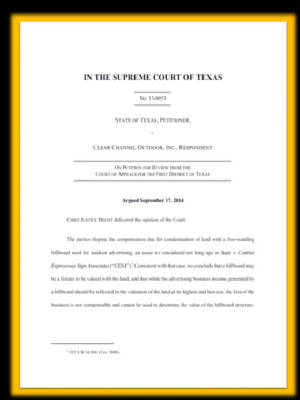
3. Texas Supreme Court Ruling in the Clear Channel Case
In the Spring, 2015, the Texas Supreme Court ruled on the earnings-based income approach in the Clear Channel billboard case. Significantly, the Court held that “…[while] business income should be reflected in the valuation of the land at its highest and best use, the loss of the business is not compensable.”
From a valuation standpoint, in presenting the earnings-based income approach, Clear Channel’s appraiser made several mistakes:
(a) Business profit was never separated and excluded from the analysis. So, the capitalized value conclusion included the intangible portion of Clear Channel’s business.
(b) Market rent and market operating expenses were not developed. Therefore, the fee simple market value was not appraised.
(c) The development of the capitalization rate was based on sale data that may have included non-real estate items. This was not clarified in the appraisal report and the Court addressed this issue on Page 15 of their ruling.
First, as an eminent domain attorney you should be aware that this decision by the Texas Supreme Court did not reject or prohibit the earnings-based income approach as evidence of market value. Rather, the Court held the view consistent with previous rulings that business income where profit is included cannot be capitalized to reflect just compensation.
Second, the Court expressed the opinion that a relationship exists between good locations and higher business income, stating that “…[higher] business income should be reflected in the value of the land…”. For eminent domain attorneys, this is an important conceptual breakthrough because for the first time this statement articulates the truth that good locations inherently generate higher business earnings.
|
||||||||||||||||||||||